
The economics of steel pipe manufacturing are changing.
Many manufacturers are no longer producing only a limited number of pipe sizes in long, continuous campaigns.
Instead, they increasingly need to respond to customer orders involving different diameters, wall thicknesses, and delivery schedules.
This creates a challenge:
How can a tube mill remain profitable when production batches become smaller, and size changes become more frequent?
One important part of the answer is reducing non-productive changeover time.
1. Small Batches Change the Production Equation
Consider two steel pipe manufacturers.
Factory A produces a limited number of pipe sizes in large batches.
Factory B produces many sizes in smaller batches.
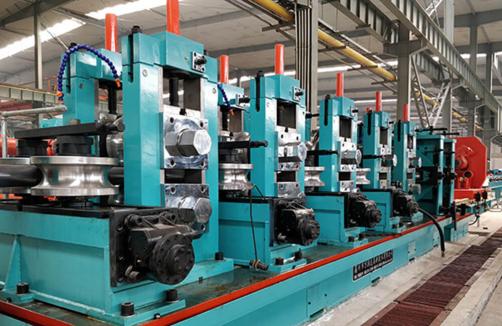
Even if both factories operate similar ERW Tube Mills, their production economics may be very different.
Factory B may spend considerably more time on:
· Roll changes
· Tooling adjustments
· Welding setup
· Trial production
· Quality confirmation
These activities reduce the time available for commercial production.
2. Changeover Frequency Matters More Than a Single Changeover
When evaluating a roller quick change system, manufacturers often focus on how many hours can be saved during one size change.
However, the annual impact depends on how frequently changes occur.
Consider a hypothetical example:
A factory performs 100 size changes per year.
Its conventional changeover procedure requires 12 hours.
A new quick change arrangement reduces this to 7 hours.
The annual time recovered would be:
100 × (12 − 7) = 500 hours
These are illustrative assumptions, not guaranteed performance figures.
The actual savings depend on the mill design, tooling system, operating procedures, and product mix.
Nevertheless, the example shows why changeover frequency is essential when evaluating investment value.
3. Recovered Time Is Not Automatically Additional Revenue
An important distinction is that reducing downtime does not necessarily create additional sales.
The recovered production hours generate financial value only when the factory can use them productively.
This depends on:
· Customer demand
· Raw material availability
· Production scheduling
· Downstream capacity
· Labor arrangements
· Quality performance
For a factory operating near capacity, recovered hours may allow additional saleable output.
For a factory with substantial unused capacity, the immediate financial benefit may instead come from scheduling flexibility and improved delivery performance.
4. Quick Change Can Improve Customer Responsiveness
A manufacturer with shorter changeover times may be better positioned to accept:
· Smaller orders
· Urgent deliveries
· More varied specifications
· Shorter production campaigns
This flexibility can be commercially important in markets where customers demand a wider range of products.
However, the value of this flexibility depends on the manufacturer's actual customer base and pricing strategy.
5. Calculate the Complete Investment
A realistic ROI evaluation should include more than the quick change mechanism itself.
Depending on the system, additional costs may involve:
· Spare roll assemblies
· Additional shafts or cassettes
· Handling equipment
· Tooling preparation areas
· Operator training
· Maintenance
The evaluation should compare total incremental investment against expected annual economic benefits.
Final Thoughts
Roller quick change systems are particularly valuable when production flexibility becomes a competitive requirement.
Their economic benefit is not simply that rolls can be changed faster.
It is that manufacturers can potentially reduce non-productive time, improve scheduling flexibility, and respond more efficiently to changing customer demand.
For a modern ERW Tube Mill, changeover efficiency should be evaluated as part of the production strategy — not just as an equipment feature.
#RollerQuickChange #ERWTubeMill #TubeMillInvestment #ProductionEfficiency #SteelPipeManufacturing #ManufacturingROI #FlexibleManufacturing
Contact WRD