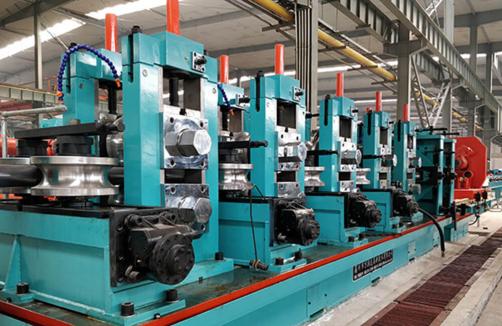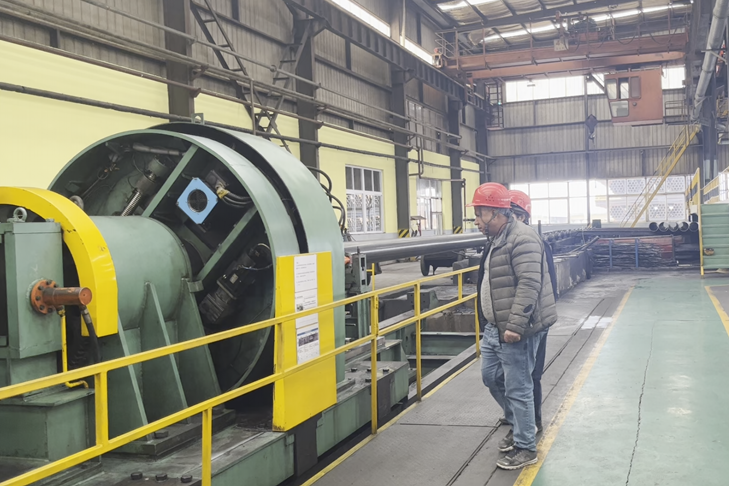

The steel pipe industry is entering a new phase of transformation.
Traditional manufacturing models based only on equipment capacity and labor efficiency are gradually being replaced by intelligent production systems driven by automation, digitalization, and AI-assisted manufacturing management.
For ERW tube mills and API pipe production facilities, this transformation is becoming increasingly important.
Global competition is no longer simply about who can produce more steel pipes.
The future belongs to manufacturers who can achieve:
· Higher production stability
· Better quality consistency
· Faster commissioning
· Lower energy consumption
· Smarter process control
· Predictive maintenance capability
Why Smart Manufacturing Matters in Pipe Production
In conventional tube mill operations, many production adjustments rely heavily on operator experience.
This includes:
· Forming adjustment
· Welding control
· Sizing correction
· Flying saw synchronization
· Production speed balancing
However, manual adjustments often introduce instability into the production process.
Modern smart manufacturing systems aim to reduce this variability through:
· Real-time monitoring
· Intelligent automation
· Data collection
· Process visualization
· AI-assisted diagnostics
This significantly improves production efficiency and product consistency.
Automation Is Becoming a Core Competitive Advantage
In today’s steel pipe industry, automation is no longer optional.
Modern ERW pipe mills increasingly integrate:
· PLC control systems
· Servo synchronization
· Intelligent HMI systems
· Online inspection equipment
· Automated roller adjustment
· Real-time production monitoring
These technologies help manufacturers reduce:
· Downtime
· Scrap rates
· Labor dependency
· Human error
At the same time, they improve production repeatability and long-term reliability.
AI Will Reshape Industrial Manufacturing
Artificial intelligence is beginning to influence industrial production in multiple ways.
In steel pipe manufacturing, AI may help optimize:
· Production scheduling
· Welding parameter adjustment
· Defect prediction
· Equipment maintenance
· Energy management
· Quality inspection systems
Future pipe mills may gradually evolve toward self-optimizing production systems capable of adjusting process parameters automatically based on production data.
Although industrial AI is still developing, manufacturers who prepare early will gain significant long-term advantages.
The Importance of Engineering Experience
Despite rapid advances in automation and AI, engineering experience remains irreplaceable.
Successful tube mill projects still require:
· Process understanding
· Mechanical design knowledge
· Material behavior experience
· Production line integration capability
· Real-world commissioning expertise
Technology alone cannot replace deep industry knowledge.
The most successful manufacturers will combine intelligent systems with experienced engineering teams.
Global Opportunities in the Steel Pipe Industry
Large investments in energy infrastructure continue across:
· Middle East
· Southeast Asia
· North Africa
· Central Asia
· South America
Many manufacturers are upgrading production capability for:
· API 5L pipes
· API 5CT pipes
· OCTG products
· Precision steel tubes
· Structural pipe applications
This creates strong long-term demand for advanced ERW tube mills and complete pipe production solutions.
The future of steel pipe manufacturing will belong to companies that can combine reliable equipment, smart manufacturing systems, and long-term engineering support.
#ERW #TubeMill #SmartManufacturing #IndustrialAutomation #SteelPipe #AIManufacturing #OCTG #API5L #DigitalFactory #Industry40 #FFXforming #Quickchange
Contact WRD