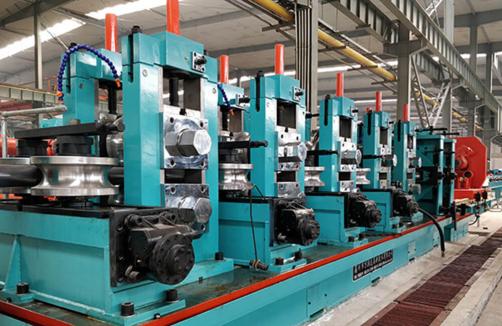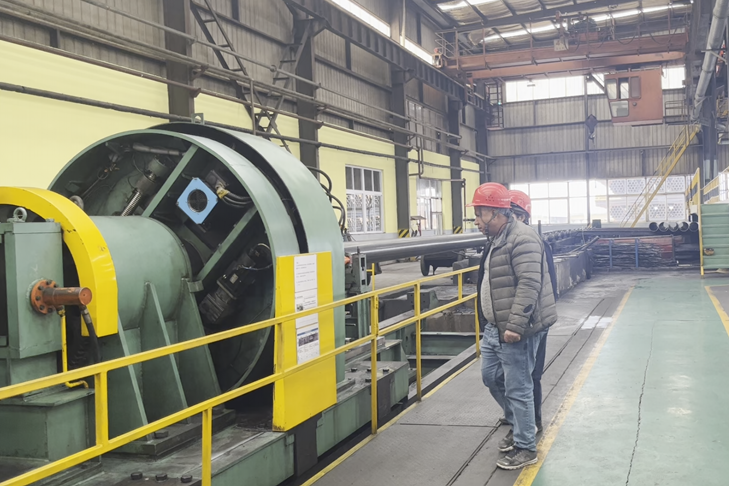

When people discuss an API Pipe Production Line, most of the attention naturally goes to the forming mill and high-frequency welding system.
But for an API pipe manufacturer, producing the pipe is only part of the job.
The plant must also demonstrate—consistently and traceably—that the product meets the required specification.
That makes inspection, testing, and traceability a fundamental part of API Pipe Mill design.
After more than 25 years involved in steel pipe production lines, we have seen projects where excellent forming equipment was installed, but inspection and finishing systems were considered too late.
The result can be an unbalanced factory.
Quality Control Should Not Begin at Final Inspection
One of the most important principles in API pipe manufacturing is that quality should be controlled throughout the process.
If quality problems are detected only at the end of the line, the manufacturer has already invested:
· Material
· Energy
· Labor
· Machine time
· Handling
· Testing capacity
into a pipe that may eventually be rejected.
Earlier process information helps identify problems before they become expensive.
Why NDT Is Critical in API Pipe Production
Non-destructive testing plays an important role in verifying pipe integrity without damaging the finished product.
Depending on the pipe specification, manufacturing route, and customer requirements, inspection technologies may include methods such as:
· Ultrasonic testing
· Eddy current testing
· Other applicable non-destructive examination systems
The correct inspection configuration should not be selected simply by asking:
“Which NDT machine should we buy?”
A better question is:
“What defects must the manufacturing system identify, at which stage, and according to which product requirements?”
That approach leads to better equipment integration.
Hydrostatic Testing Is Also a Production-Capacity Issue
Hydrostatic testing is often treated purely as quality-control equipment.
From a plant-design perspective, however, it is also a production asset with its own cycle time.
The project team should evaluate:
· Pipe size range
· Pipe length
· Required test conditions
· Loading and unloading cycle
· Buffer capacity
· Production sequence
If the tube mill produces faster than the downstream testing section can process, finished pipes begin accumulating.
Eventually, the nominal mill capacity becomes irrelevant.
The hydrotester — not the tube mill — controls plant output.
Traceability Is Becoming Increasingly Important
Modern API pipe manufacturing requires strong control of production information.
Depending on the manufacturer's quality system and product requirements, traceability may connect information such as:
· Raw material identification
· Coil information
· Production batch
· Process parameters
· Inspection results
· Test results
· Finished pipe identification
The objective is straightforward:
A manufacturer should be able to connect the finished pipe with the relevant manufacturing and quality records.
This becomes especially important when supplying:
· Oil & gas companies
· Pipeline contractors
· Large EPC projects
· International energy infrastructure projects
For these customers, documentation is part of the product.
Automation Can Connect Production and Quality
One of the important developments in modern pipe manufacturing is the integration of production data and quality information.
Instead of operating each machine as an isolated unit, a more advanced production line can connect information from:
· Mill control
· Welding
· Measurement
· NDT
· Hydrotesting
· Finishing
This gives production managers a clearer picture of what is happening across the plant.
Over time, such data can also support:
· Process optimization
· Root-cause analysis
· Preventive maintenance
· Quality improvement
The future API Pipe Mill will increasingly become a data-driven manufacturing system.
Do Not Undersize the Inspection Section
For investors, there is an important practical lesson here:
Inspection equipment should be evaluated according to the production target of the entire plant.
Project teams should ask:
· Can inspection keep pace with production?
· What happens during product changeovers?
· Where will pipes accumulate?
· Is sufficient buffering provided?
· Can rejected pipes be separated efficiently?
· How will production data be stored and traced?
These questions influence plant efficiency just as much as forming speed.
Quality Equipment Does Not Replace Process Control
Another important distinction is that inspection technology cannot compensate for an unstable manufacturing process.
NDT can identify problems.
It cannot make an unstable weld stable.
Hydrotesting can verify performance.
It cannot correct inaccurate forming.
The strongest API Pipe Mills combine:
· Stable forming
· Stable welding
· Reliable inspection
· Effective quality management
The objective should be prevention first, verification second.
Final Thoughts
An API Pipe Production Line should not be designed as:
Manufacturing equipment + inspection equipment
It should be designed as one integrated manufacturing and quality system.
After more than 25 years of experience with ERW Tube Mills and API Pipe Mill projects, we believe the strongest plants are those where quality control is considered from the earliest engineering stage.
In API pipe manufacturing, the customer is not only buying steel pipe.
They are buying consistent performance supported by reliable manufacturing records.
#APIPipeMill #NDT #API5L #API5CT #ERWTubeMill #SteelPipeQuality #HydrostaticTesting #OCTG #QualityControl #SteelPipeManufacturing
Contact WRD