
When planning a new API Pipe Production Line, investors often begin with a simple target:
“We need a 200,000-ton-per-year plant.”
The next question is usually:
“What production speed should the tube mill have?”
But this calculation can be misleading.
After more than 25 years in steel pipe production line engineering, we have learned that the rated speed of the ERW Tube Mill is only one part of the capacity equation.
The real capacity of an API pipe factory is determined by the slowest part of the complete manufacturing system.
Rated Mill Speed Is Not Annual Plant Capacity
A mill may be mechanically capable of running at a certain maximum speed.
But a factory does not operate continuously at maximum speed 365 days a year.
Actual output is affected by:
· Product mix
· Pipe diameter
· Wall thickness
· Steel grade
· Coil change
· Size changeover
· Maintenance
· Inspection
· Finishing
· Production scheduling
Therefore:
Maximum line speed ≠ Effective production capacity
This distinction is essential when building the business case for a new API Pipe Mill.
Start With the Product Mix
Two factories using similar equipment can have very different annual output.
Consider two production strategies.
Factory A produces:
· Long campaigns
· Limited pipe sizes
· Similar wall thicknesses
Factory B produces:
· Many diameters
· Multiple wall thicknesses
· Smaller order batches
· Frequent specification changes
Even if both mills have the same maximum speed, Factory A may achieve much higher annual tonnage.
That is why capacity planning must begin with the expected sales and production mix.
Changeover Time Must Be Included
Every product change consumes productive time.
Depending on mill design, changeover activities may include:
· Roll changes
· Tool adjustment
· Mill alignment
· Welding setup
· Sizing adjustment
· Trial production
· Quality confirmation
If a plant changes products frequently, this can represent a significant portion of available production hours.
This is why technologies such as:
· FFX forming
· Roller quick change systems
· Automated adjustment
can have financial value beyond convenience.
They increase effective production time.
Find the Real Bottleneck
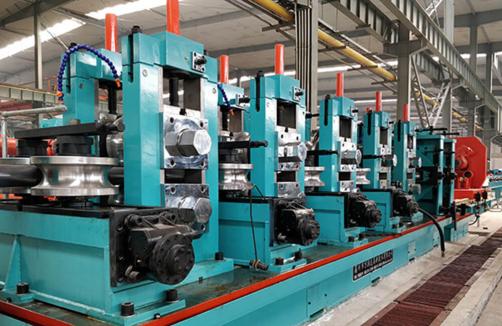
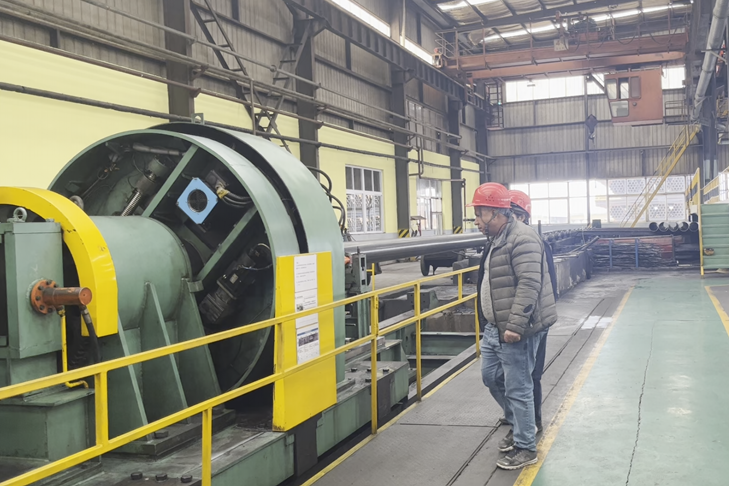
An API Pipe Production Line may include:
· Coil handling
· ERW tube mill
· NDT
· Heat treatment where applicable
· Hydrostatic testing
· Straightening
· End finishing
· Threading
· Coupling operations
· Final inspection
· Packing
Each process has its own cycle time.
Suppose the ERW mill can produce 40 pipes per hour, but a downstream operation can process only 28.
The factory does not have a 40-pipe-per-hour system.
It effectively has a 28-pipe-per-hour system unless buffering or parallel capacity resolves the bottleneck.
This is why complete line balancing is essential.
Material Handling Is Often an Invisible Bottleneck
Large API pipe plants move significant quantities of heavy material.
Poorly designed handling systems can create delays between operations.
Project planners should consider:
· Pipe transfer systems
· Accumulation areas
· Buffer zones
· Cranes
· Offline processing
· Finished-product logistics
A machine waiting for material is not producing.
A machine blocked because the next station is full is also not producing.
Good material flow is therefore part of production technology.
Maintenance Availability Must Be Included
No industrial production line operates without maintenance.
Realistic capacity calculations should include:
· Preventive maintenance
· Tool inspection
· Roll maintenance
· Welding equipment service
· Electrical maintenance
· Unexpected downtime
Designing the project around 100% theoretical availability creates unrealistic financial expectations.
Experienced project planning uses effective operating time rather than brochure speed.
Quality Yield Also Changes Sellable Capacity
There is another important number:
Good finished pipe output.
A factory may produce a certain tonnage before inspection, but the commercially meaningful figure is the amount of conforming product available for shipment.
Factors affecting yield include:
· Raw material quality
· Process stability
· Welding consistency
· Dimensional control
· Operator performance
For an investor, saleable annual tonnage is more important than gross mill output.
How Should Investors Evaluate Capacity?
Before approving an API Pipe Mill configuration, consider these questions:
1. What is our expected product mix?
2. How often will we change sizes?
3. What is the average wall thickness?
4. Which downstream processes are required?
5. What is the cycle time of each major process?
6. Where are the potential bottlenecks?
7. How much buffer capacity is needed?
8. What realistic operating availability should we use?
9. What yield should be assumed?
10. Can the line expand if demand increases?
Only after answering these questions should annual production capacity be finalized.
Final Thoughts
A successful API Pipe Mill project should be designed around balanced capacity, not simply maximum machine speed.
After more than 25 years in steel pipe production equipment, we have seen that the best-performing plants are often not those with the fastest individual machines.
They are the plants where:
· Production processes are balanced
· Changeovers are efficient
· Material flows smoothly
· Testing keeps pace with manufacturing
· Downtime is controlled
· Quality yield remains high
For investors and project managers, this distinction can make the difference between a production line that looks impressive on paper and one that delivers strong financial performance in the real factory.
#APIPipeProductionLine #APIPipeMill #ERWTubeMill #API5L #API5CT #TubeMillCapacity #SteelPipeManufacturing #OCTG #PlantEngineering #ManufacturingEfficiency
Contact WRD