1. What is FFX forming technology in a tube mill?
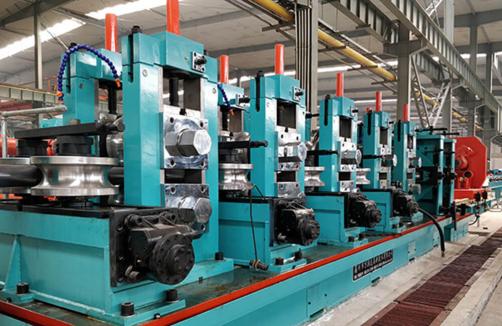
FFX is a flexible forming approach used in ERW tube mills to improve production flexibility across different pipe sizes.
Compared with traditional forming arrangements that may require more size-specific tooling, flexible forming concepts can reduce the number of dedicated rolls required in parts of the forming section.
The actual benefits depend on the mill design, product range and production program.
2. What are the main advantages of FFX forming?
Depending on the application and equipment design, the potential advantages can include:
· Reduced dedicated roll requirements
· Faster size adjustment
· Improved production flexibility
· Lower tooling inventory
· Better suitability for multiple product sizes
For manufacturers producing many diameters or relatively small batches, these advantages can have a significant impact on lifecycle operating cost.
3. Does FFX reduce roll cost?
FFX can reduce the requirement for size-specific forming rolls in applicable sections of the mill.
The actual savings depend on:
· Number of pipe sizes
· Product range
· Roll design
· Changeover strategy
· Production program
Therefore, investors should compare total tooling requirements across the expected product portfolio rather than only the roll cost for one pipe size.
4. Is FFX always better than conventional forming?
No.
The correct forming technology depends on the business case.
A manufacturer producing a narrow range of pipe sizes in long production campaigns may have different priorities from a manufacturer producing dozens of sizes with frequent changeovers.
FFX becomes particularly interesting when production flexibility and tooling optimization have significant economic value.
5. What is DFT in tube and pipe manufacturing?
DFT, or Direct Forming Technology, is used to produce square and rectangular hollow sections through a direct forming route rather than always forming a complete round tube first and then converting it into the final square or rectangular shape.
Depending on the product mix and line design, DFT can offer advantages in tooling utilization, changeover efficiency and production flexibility.
6. What is the difference between direct forming and round-to-square forming?
In the conventional round-to-square route, the strip is first formed and welded as a round tube and then reshaped into a square or rectangular section.
In direct forming, the section is progressively formed toward the target square or rectangular geometry through a different forming route.
Each method has its own advantages and should be selected according to product dimensions, wall thickness, corner requirements, production mix and investment objectives.
7. How much time can a quick-change system save on a tube mill?
The actual size-change time depends on the tube mill design, tooling system, automation level, product range and operator experience.
Quick-change systems can significantly reduce non-productive changeover time, particularly for manufacturers producing multiple sizes in smaller batches.
For investment evaluation, the most useful calculation is not simply “hours saved per changeover,” but the additional annual productive hours created by faster changeovers.
8. Is a roller quick-change system worth the investment?
It depends mainly on production frequency and product mix.
For a factory producing one size continuously for long campaigns, the economic benefit may be limited.
For a factory with frequent size changes, a quick-change system can improve equipment utilization and reduce production losses.
The investment should therefore be evaluated using expected annual changeovers and the value of recovered production time.
9. How should I choose between FF, FFX and other forming systems?
The decision should consider:
· Product size range
· Wall thickness
· Steel strength
· Number of sizes
· Average batch size
· Changeover frequency
· Roll investment
· Operator requirements
· Initial CAPEX
· Long-term operating cost
The best forming technology is the one that matches the manufacturer's actual production strategy.
10. Can an existing tube mill be upgraded with more flexible forming or quick-change technology?
In some cases, existing mills can be upgraded or modified, but feasibility depends on the original mechanical design, stand arrangement, drive system, foundation, automation and available space.
A technical assessment of the existing line is normally required before determining whether an upgrade is economically practical.