1. What is an ERW tube mill?
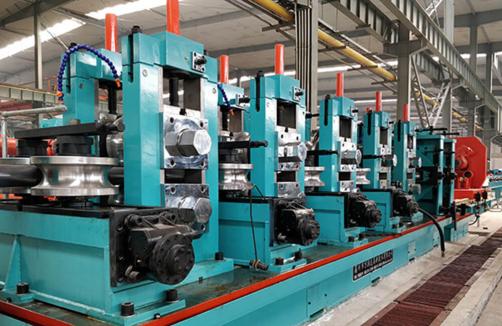
An ERW tube mill is a production line used to manufacture electric resistance welded steel pipes and tubes from steel coil. A typical ERW tube mill includes coil handling, strip preparation, forming, high-frequency welding, sizing, cutting and finishing equipment.
Depending on the configuration, ERW tube mills can produce round pipes as well as square and rectangular hollow sections for construction, structural, mechanical, water transmission, oil and gas, and other industrial applications.
2. How does an ERW tube mill work?
Steel coil is uncoiled and continuously formed into an open round section through a series of forming rolls. The strip edges are then heated by high-frequency welding and joined under pressure. After welding, the pipe is sized to the required dimensions, cut to length and transferred to downstream inspection or finishing equipment.
For higher-specification applications such as API pipe production, additional testing, inspection and finishing processes may be required.
3. How much does an ERW tube mill cost?
The price of an ERW tube mill depends on the pipe diameter range, wall thickness, steel grade, production speed, forming technology, automation level and required downstream equipment.
A small conventional tube mill and a large API pipe production line can therefore have very different investment levels.
For an accurate budget, a supplier normally needs at least the required pipe OD range, wall thickness range, material grade, product standard, annual capacity and finished product type.
4. What information is required to quote an ERW tube mill?
To prepare a suitable technical proposal and quotation, the following information is normally required:
· Minimum and maximum pipe OD
· Wall thickness range
· Round, square or rectangular product range
· Steel grade or yield strength
· Applicable product standards
· Required production capacity
· Pipe length
· Available coil specifications
· Required inspection and finishing processes
The more complete the product matrix, the more accurately the production line can be engineered.
5. What is the difference between an ERW tube mill and an API pipe mill?
A standard ERW tube mill may produce structural, mechanical or general-purpose welded steel pipes.
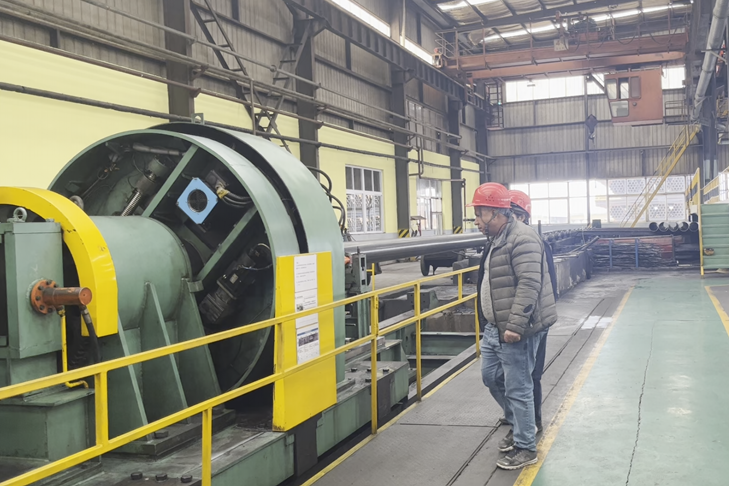
An API pipe mill is configured to manufacture pipes according to applicable API product requirements, such as API 5L line pipe or API 5CT casing and tubing. Such projects generally require more comprehensive process control, inspection, testing, traceability and downstream finishing systems.
Therefore, an API pipe mill should be evaluated as a complete manufacturing and quality-control system rather than simply an ERW forming and welding machine.
6. What determines the production speed of an ERW tube mill?
Production speed depends on several factors, including:
· Pipe diameter
· Wall thickness
· Steel grade
· Welding capacity
· Forming process
· Cutting system
· Required product quality
· Downstream processing capacity
The maximum mechanical speed of the mill should not be confused with sustainable production speed.
For industrial projects, stable output and good-product yield are usually more important than the highest theoretical speed.
7. How do I choose the right ERW tube mill?
Start with the finished products you plan to sell rather than the machine itself.
Define the expected product mix, including pipe sizes, wall thicknesses, steel grades, annual tonnage, applicable standards and average batch sizes.
The supplier can then determine the appropriate forming system, drive capacity, welding system, automation level, inspection equipment and finishing configuration.
A well-designed tube mill should balance initial investment, production flexibility, operating cost and future expansion requirements.
8. Can one ERW tube mill produce both round and square pipes?
Yes. Many ERW tube mills can be configured to produce round pipes and square or rectangular hollow sections.
Square and rectangular products can be produced through different process routes, including forming a round tube first and then sizing it into a square or rectangular section, or using a direct forming process.
The most suitable method depends on the product range, wall thickness, production volume and investment strategy.
9. How long does it take to install and commission an ERW tube mill?
The schedule depends heavily on the size and complexity of the production line.
A complete project includes more than machine manufacturing. Engineering confirmation, foundation preparation, utilities, shipment, installation, electrical integration, commissioning, trial production and operator training must all be coordinated.
For larger API pipe projects, project planning should begin well before equipment arrives at the factory.
10. What should buyers compare when evaluating ERW tube mill suppliers?
Do not compare only maximum speed and total price.
Buyers should also evaluate:
· Engineering experience
· Similar project references
· Forming technology
· Equipment rigidity
· Welding process capability
· Changeover efficiency
· Automation
· Spare-parts strategy
· Commissioning capability
· Long-term technical support
For a production line expected to operate for many years, lifecycle performance is often more important than the initial equipment price.