
In the global steel pipe manufacturing industry, production efficiency, dimensional accuracy, flexibility, and operating cost have become key factors determining competitiveness.
As demand continues to grow for:
· API 5L line pipe
· Oil & gas transmission pipe
· Structural steel pipe
· Large diameter welded pipe
· High-strength steel tube production
More manufacturers are re-evaluating one critical question:
Should we continue using Traditional Forming technology, or move toward Direct Forming systems?
After decades of development in ERW pipe mill and API pipe production line engineering, Direct Forming has gradually become one of the most discussed technologies in modern welded pipe manufacturing.
This article explains the technical differences, production advantages, and investment considerations between Direct Forming and Traditional Forming.
What is Traditional Forming?
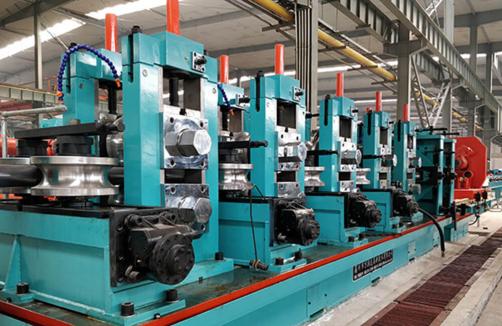
Traditional Forming refers to the conventional roll forming process used in many ERW tube mills and API pipe mills.
In this process:
1. The steel strip enters the breakdown section
2. The strip is gradually bent through multiple forming stands
3. Different pipe sizes require different roll sets
4. The pipe is welded by the HF welding system
5. Sizing and finishing processes follow
This technology has been widely used for decades due to its maturity and stability.
Advantages of Traditional Forming
· Proven and reliable technology
· Stable forming process
· Suitable for mass production of fixed pipe sizes
· Lower initial investment in some configurations
· Easier operation for traditional factories
Limitations of Traditional Forming
· Large quantity of rolls required
· Long roll change time
· High roll inventory cost
· Reduced flexibility for multi-size production
· More downtime during size conversion
For manufacturers handling frequent specification changes, these limitations can significantly affect production efficiency and profitability.
What is Direct Forming?
Direct Forming is an advanced tube mill forming technology designed to improve flexibility, reduce tooling requirements, and optimize production efficiency.
Unlike traditional systems, Direct Forming allows the steel strip to be formed directly into pipe shape with a more flexible forming strategy.
In many modern Direct Forming pipe mills:
· One set of rolls can cover multiple pipe sizes
· Roll adjustment becomes easier
· The size change time is dramatically reduced
· Production flexibility increases significantly
This technology is becoming increasingly popular in:
· Structural tube mills
· High-frequency welded pipe production lines
· Smart manufacturing steel plants
Direct Forming vs Traditional Forming: Key Technical Comparison
1. Roll Consumption
Traditional Forming:
· Requires a large number of roll sets
· Higher tooling investment
· Larger storage requirements
Direct Forming:
· Significantly fewer rolls required
· Lower long-term tooling cost
· Simplified roll management
For factories producing multiple pipe specifications, Direct Forming can greatly reduce operational complexity.
2. Size Change Efficiency
Traditional Forming:
· Long downtime during roll replacement
· Higher labor intensity
· Reduced production flexibility
Direct Forming:
· Faster adjustment process
· Reduced changeover time
· Better suited for flexible manufacturing
This is especially important for manufacturers handling small-batch and multi-specification orders.
3. Production Flexibility
Modern steel pipe markets increasingly demand:
· Smaller order quantities
· Faster delivery
· More specification diversity
Direct Forming technology provides clear advantages in flexible production environments.
Traditional systems remain highly effective for long-term, single-size mass production.
4. Production Cost
Although Direct Forming systems may require higher initial engineering precision and advanced automation integration, they often reduce:
· Roll investment
· Downtime losses
· Labor costs
· Maintenance complexity
Over the long term, many manufacturers achieve better ROI through improved efficiency and flexibility.
Which Technology is Better for Welded Pipe Mills?
The answer depends on:
· Product strategy
· Production volume
· Pipe specification range
· Customer order structure
· Automation goals
· Future expansion planning
Traditional Forming is suitable for:
· Stable high-volume production
· Round, square, and rectangular tubes are all available
· Limited specification changes
· Lower initial investment projects
Direct Forming is suitable for:
· Only square and rectangular tubes
· Multiple sectional pipe sizes
· Smart factory upgrades
· High-efficiency API pipe production
· Future-oriented manufacturing strategies
Industry Trend: Why More Pipe Manufacturers Are Choosing Direct Forming
Global competition in the welded pipe industry is shifting from pure production capacity toward:
· Intelligent manufacturing
· Flexible production
· Lower operating cost
· Faster delivery capability
· Digitalized pipe mill management
As a result, Direct Forming technology is becoming a major development direction for modern ERW pipe mills and API tube production lines.
Many new-generation steel pipe factories now prioritize:
· Automatic roll adjustment
· Fast size conversion
· Reduced tooling dependency
· Higher efficiency production systems
These are exactly the areas where Direct Forming demonstrates significant advantages.
Final Thoughts
Both Traditional Forming and Direct Forming have important roles in modern steel pipe manufacturing.
Traditional systems remain highly reliable and effective for many applications.
However, for manufacturers seeking:
· Higher efficiency
· Flexible production
· Lower tooling cost
· Faster specification change
· Future-ready API pipe production
Direct Forming is increasingly becoming the preferred solution.
At WRD / TJZD, we have focused on welded steel pipe production technology for more than 25 years, providing complete ERW pipe mill, DFT pipe mill, and API pipe production line solutions for global customers in oil & gas, structural steel, and industrial pipe manufacturing industries.
As the industry continues evolving toward intelligent and flexible manufacturing, Direct Forming technology will likely play an even more important role in the next generation of steel pipe production.
#DirectForming #TraditionalForming #PipeMill #TubeMill #ERWPipeMill #APIPipe #SteelPipe #WeldedPipe #PipeManufacturing #TubeManufacturing #OilAndGas #API5L #SteelIndustry #IndustrialManufacturing #SmartManufacturing
Contact WRD