1. What equipment is required for an API 5L pipe production line?
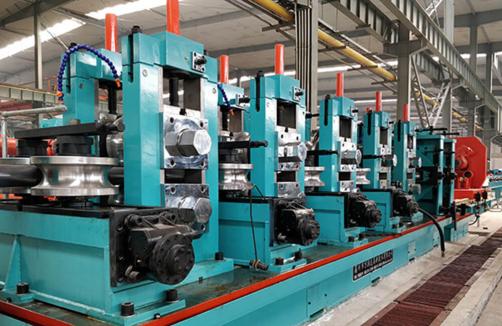
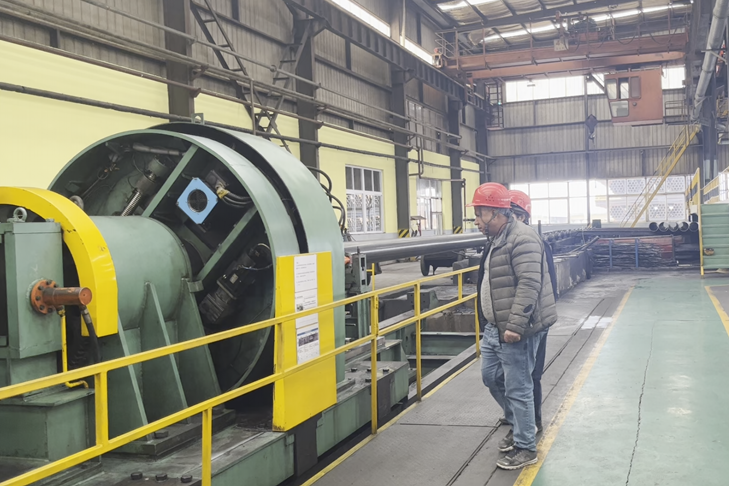
A complete API 5L ERW pipe production line may include:
· Coil handling and uncoiling
· Strip preparation and joining
· Accumulator
· Forming section
· High-frequency welding system
· Weld bead treatment
· Sizing section
· Flying cut-off
· NDT equipment
· Hydrostatic testing
· Straightening
· End facing or beveling
· Measuring and marking
· Final inspection
· Material handling and packing systems
The exact configuration depends on the pipe size, wall thickness, steel grade, product specification and customer requirements.
2. What is the difference between API 5L and API 5CT pipe production lines?
API 5L primarily covers line pipe used in pipeline transportation systems, while API 5CT covers casing and tubing used in oil and gas wells.
The manufacturing and finishing requirements can therefore differ significantly.
An API 5CT OCTG project may require additional processes such as heat treatment, threading, coupling production or processing, inspection and specialized finishing depending on the intended product range.
The production line should always be designed around the specific products and applicable requirements.
3. Can ERW technology be used to produce API 5L pipes?
Yes. ERW is widely used for many welded API line pipe applications when the manufacturing process, raw materials, welding, inspection and testing meet the applicable requirements.
However, not every conventional ERW tube mill should automatically be considered suitable for API production.
The complete production system must be designed for the intended pipe specification, steel grade and quality requirements.
4. What should be considered before investing in an API pipe mill?
Before equipment selection, investors should define:
· API 5L or API 5CT product strategy
· Pipe OD and wall thickness range
· Steel grades
· Target annual production
· Target customers and markets
· Required inspection systems
· Required finishing processes
· Future expansion strategy
These decisions determine both CAPEX and the long-term competitiveness of the factory.
5. How much does an API pipe mill cost?
There is no single standard price for an API pipe mill.
Investment varies significantly depending on:
· Pipe size range
· Maximum wall thickness
· Steel strength
· Annual capacity
· Forming technology
· HF welding system
· Automation
· NDT and testing systems
· Finishing equipment
· Material handling
· Level of turnkey engineering
A meaningful budget should therefore be based on a defined product matrix and process route rather than only the maximum pipe diameter.
6. What is the best forming technology for an API pipe mill?
There is no universal forming technology that is best for every API pipe project.
The correct choice depends on product range, production volume, size-change frequency, wall thickness, steel grades, roll investment and desired flexibility.
Conventional forming and flexible forming technologies such as FFX can each be appropriate under different production strategies.
The decision should be based on total lifecycle economics rather than the technology name alone.
7. Why is NDT important in an API pipe production line?
Non-destructive testing helps verify pipe and weld quality without destroying the finished product.
Depending on the product and applicable requirements, an API pipe production system may incorporate ultrasonic testing, electromagnetic inspection or other NDT methods.
NDT should be integrated with the manufacturing and quality-control strategy rather than treated simply as an independent machine installed at the end of production.
8. How is the real annual capacity of an API pipe mill calculated?
Annual capacity should not be calculated only from the maximum tube mill speed.
A realistic capacity model should consider:
· Product mix
· Pipe weight per meter
· Actual production speed by specification
· Operating hours
· Size-change time
· Maintenance downtime
· Inspection and finishing cycle times
· Production yield
The real capacity of the plant may ultimately be determined by its slowest critical process.
9. Can an API pipe mill be expanded in the future?
Yes, if future expansion is considered during initial engineering.
Possible provisions include additional factory space, electrical capacity, foundations, equipment interfaces and downstream expansion areas.
This can allow future additions such as higher-capacity inspection, additional finishing equipment or expanded product ranges without rebuilding the entire plant.
10. Should I buy an API pipe mill from one turnkey supplier or multiple suppliers?
Both models can work.
Multiple specialized suppliers may be suitable for manufacturers with strong internal engineering and system-integration capabilities.
A turnkey approach can reduce interface and coordination risks by assigning greater responsibility for process design, equipment integration, layout, automation and commissioning to one engineering partner.
The key question is not simply how many suppliers are involved, but who is responsible for the performance of the complete production system.