
Many people assume that API pipe manufacturing is simply a higher-grade version of standard ERW pipe production.In reality, API pipe production requires a completely different level of process control, engineering precision, and production stability.
As global demand for oil & gas pipelines continues to increase, more steel pipe manufacturers are upgrading from conventional ERW tube production toward API 5L and API 5CT manufacturing capability.
However, the transition is far more complex than upgrading individual machines.
After over 25 years focused on steel pipe production lines, we believe understanding the differences between standard ERW production and API manufacturing is essential before investing in a new pipe mill project.
1. Product Application Requirements
Standard ERW pipes are commonly used for:
· Structural applications
· Water transmission
· Furniture tubing
· Construction materials
· Mechanical tubing
API pipes are designed for demanding oil & gas applications where safety and long-term reliability are critical.
API steel pipes must withstand:
· High pressure
· Corrosive environments
· Harsh outdoor conditions
· Long-distance transportation systems
This creates much stricter manufacturing requirements.
2. Welding Stability Requirements
In standard ERW production, small process variations may still be acceptable.
For API pipe manufacturing, welding stability becomes critical.
Key control factors include:
· Strip edge preparation
· V angle control
· High-frequency heat input
· Squeeze roll pressure
· Cooling consistency
Even small instability may affect:
· Weld seam integrity
· Hydrostatic testing performance
· Ultrasonic inspection results
· Final product reliability
3. Dimensional Accuracy
API pipes require tighter control over:
· Diameter tolerance
· Ovality
· Straightness
· Wall thickness consistency
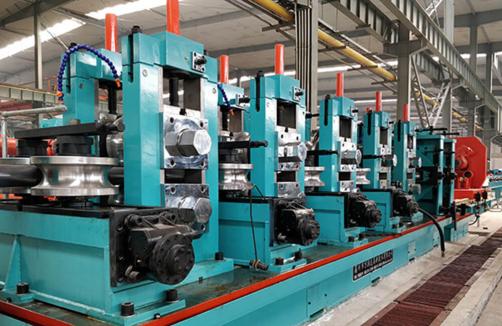
This demands more advanced sizing systems and better roll design.
4. Inspection and Testing Standards
API pipe production lines typically integrate:
· Ultrasonic testing systems
· Eddy current inspection
· Hydrostatic testing
· X-ray inspection
· Online dimensional measurement
Inspection capability is one of the biggest differences between conventional ERW production and API-grade manufacturing.
5. Process Engineering Experience
One of the most underestimated factors in API pipe manufacturing is process engineering.
Successful API production requires a deep understanding of:
· Material behavior
· Forming technology
· Welding process control
· Cooling systems
· Heat treatment
· Automation synchronization
Machines alone cannot guarantee stable API pipe production.
The Future of API Steel Pipe Manufacturing
Global energy investment continues to drive strong demand for:
· API 5L pipe mills
· API 5CT production lines
· OCTG manufacturing equipment
· Advanced ERW tube mills
At the same time, manufacturers increasingly prioritize:
· Smart manufacturing
· Intelligent automation
· Energy efficiency
· Production traceability
· Long-term process stability
The future of API pipe manufacturing belongs to companies capable of combining advanced technology with real engineering experience.
After 25 years in the steel pipe industry, we continue helping customers build reliable, stable, and efficient API pipe production systems worldwide.
#API5L #API5CT #APIPipe #ERW #TubeMill #OCTG #SteelPipe #IndustrialEngineering #OilAndGas #SmartManufacturing #API5LPipeMill #OilAndGasPipeMill
Contact WRD