
API 5L steel pipes are widely used in oil and gas transportation systems, energy infrastructure, and critical pipeline projects.
Because these applications require high reliability, API 5L pipe production demands much more than simply producing a steel tube.
It requires a highly controlled manufacturing process.
After more than 25 years specializing in steel pipe production lines, we have learned that:
For API pipe manufacturing, process stability is the foundation of product quality.
Why Is API 5L Production More Challenging?
Compared with conventional ERW steel pipes, API 5L pipes require stricter control of:
· Weld seam quality
· Dimensional accuracy
· Mechanical properties
· Inspection results
· Production consistency
A pipe mill must maintain stable performance throughout long production runs.
Small variations that may be acceptable in standard pipe production can become significant issues in API applications.
Key Factors Affecting API 5L Pipe Quality
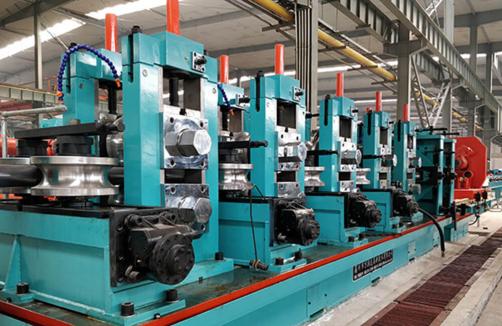
1. Strip Preparation and Forming Stability
The forming process determines the foundation of the pipe.
Important factors include:
· Strip edge condition
· Forming roll design
· Alignment accuracy
· Gradual deformation control
Unstable forming can create problems during welding and sizing.
2. High Frequency Welding Stability
The ERW welding process is one of the most critical stages.
Stable welding requires precise control of:
· Welding power
· Heat input
· Squeeze pressure
· Welding speed
· Cooling conditions
Consistent welding parameters help achieve reliable weld seam performance.
3. Dimensional Control
API 5L customers require strict control of:
· Outside diameter
· Wall thickness
· Ovality
· Straightness
The sizing section must provide stable and repeatable adjustment.
4. Inspection and Testing Capability
Modern API pipe mills often integrate:
· Ultrasonic testing
· Hydrostatic testing
· Eddy current inspection
· Online measurement systems
Inspection systems verify product quality and reduce production risks.
Why Production Stability Is More Important Than Maximum Speed
Increasing line speed may improve theoretical output.
However, unstable production can result in:
· Higher rejection rates
· More downtime
· Difficult quality control
· Increased operating cost
For API 5L production, consistent quality is often more valuable than maximum speed.
The Role of Advanced Tube Mill Technology
Modern API pipe mills increasingly adopt:
· FFX Forming Technology
· Roller Quick Change Systems
· Intelligent automation
· Digital production monitoring
These technologies help manufacturers improve:
· Production flexibility
· Equipment utilization
· Quality consistency
· Long-term competitiveness
Building a Reliable API Pipe Production System
A successful API 5L pipe mill requires integration of:
· Mechanical engineering
· Electrical automation
· Welding technology
· Process knowledge
· Commissioning experience
Equipment alone cannot guarantee successful API production.
The supplier's engineering capability and project experience are equally important.
Final Thoughts
API 5L pipe manufacturing is ultimately a process control challenge.
The most competitive manufacturers are not always those with the fastest machines.
They are those who can consistently produce high-quality pipes, maintain stable operation, and respond efficiently to market requirements.
With more than 25 years of experience in ERW Tube Mills and API Pipe Mill solutions, we continue helping global manufacturers build reliable and efficient steel pipe production systems.
#API5L #APIPipeMill #ERWTubeMill #SteelPipeManufacturing #OCTG #PipeManufacturing #TubeMill #OilAndGas
Contact WRD